

I spent two years thinking I just sucked at milk foam.
Every morning, same routine.
Watch a YouTube tutorial.
Copy exactly what the guy does.
Get thick foam that turns into watery garbage halfway through the pour.
Dump it in the sink.
Try again.
My kitchen sink drank more cappuccinos than I did.
And the worst part?
I couldn't figure out WHAT I was doing wrong.
If I made the foam thicker... didn't work.
If I made it thinner... still didn't work.
The milk was somehow too thick AND too thin at the same time.
Which didn't even make sense.
Until one day I noticed something stupid about every tutorial I'd been following.
The $27,000 Blind Spot
Every milk steaming video on YouTube teaches the same move.
The vortex.
Angle the wand. Get the milk spinning in a whirlpool. Let the whirlpool pull the foam down and mix everything into that glossy, paint-like texture.
In the videos, it works every time.
Thirty seconds of steam, perfect microfoam.
Then I looked at the machine behind the guy.
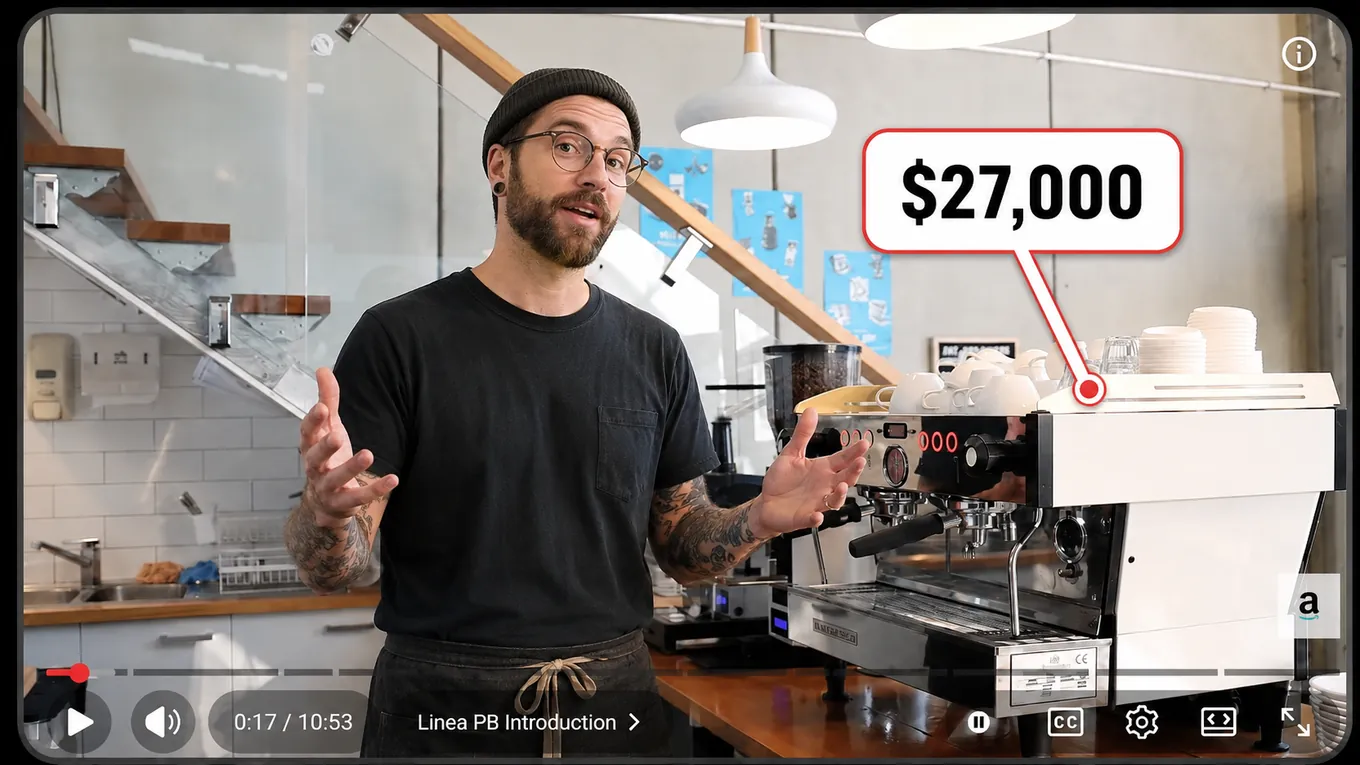
It was a La Marzocco.
A $27,000 commercial espresso machine.
Every tutorial I'd been failing at was filmed on one of these beasts.
Meanwhile I'm standing in my kitchen with a $600 Breville...
Following instructions written for a machine that costs more than my car.
And here's the thing nobody tells you about those cheap home espresso machines.
They don't have enough steam power to actually DO the vortex technique.
Where the vortex goes to die (in the bottom half of your pitcher)
On my machine, the vortex LOOKED like it was working.
The milk spun.
There was a little whirlpool at the surface.
Just like the videos.
So naturally I assumed the technique was fine and I was the idiot.
Turns out... neither.
The vortex WAS spinning my milk.
But only the top half.
Down at the bottom, the milk was just sitting there.
Untouched.
Uninvolved.
Like it didn't even get invited.
The foam stayed trapped at the surface where the spinning was happening.
Underneath the foam layer was thin, watery milk.
In the pitcher it looked... fine.
Then I'd pour.
First I'd get the thick foam blob.
Then halfway through, watery milk.
Every. Single. Time.
Two years of thinking I needed more practice...
And the actual problem was that half my pitcher wasn't even participating.
The 3-second fix that pissed me off
So the vortex needs steam power I don't have.
Cool.
What mixes a whole pitcher when your steam wand is kind of a gentle little guy?
Simple...the rolling technique.
Instead of trying to force a whirlpool your espresso machine can't even manage...
You get the milk moving in a rolling pattern.
Top over bottom.
The entire pitcher mixes.
On the same espresso machine where the vortex fails.
First time I got it right, I just stood there watching the texture change in real time.
Like I'd discovered fire.
The milk poured out silky smooth and glossy.
No thick blob.
No watery breakdown.
Just smooth, consistent microfoam from start to finish.
The heart I'd been chasing for two years held on the first pour.
And the truly annoying part?
The technique takes three seconds.
Two years of failed milk foam...
Fixed in three seconds.
And now I'm sharing my secret with you.